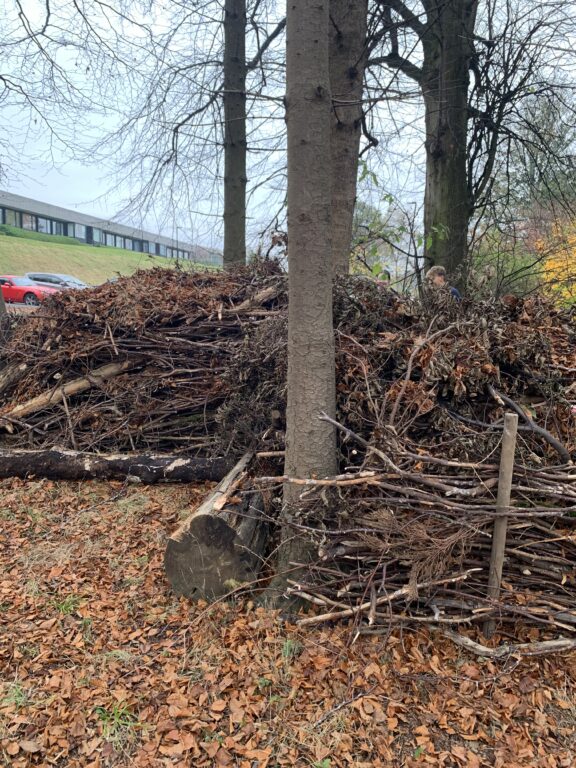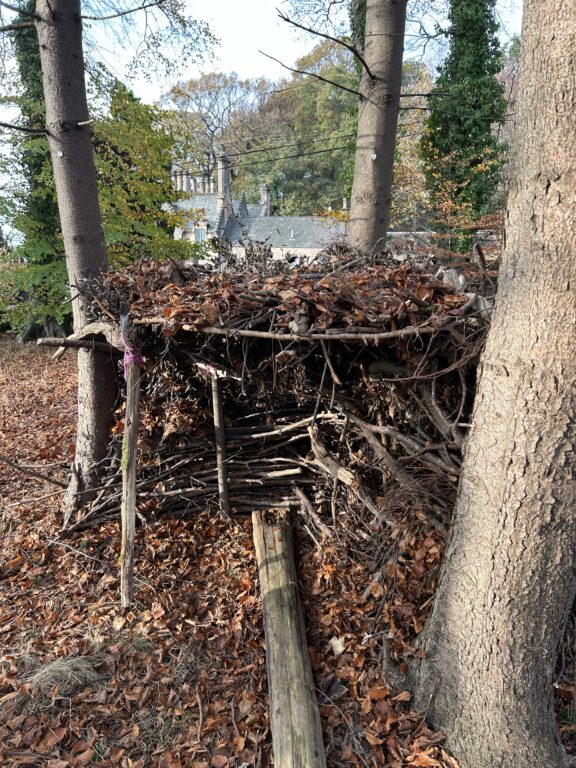
A shelter
This resource provides details of a practical seminar activity carried out by staff and tutors as part of a University of Stirling-wide interdisciplinary module entitled ‘Wicked Problems and Sustainable Solutions’. The activity requires students to make a dead hedge after they have attended a lecture entitled ‘The literary “Hedgeland”’. In the lecture, literary texts in English and French, as well as examples from the visual arts, are used to illustrate hedges as complex, symbolic sites of entanglement. The seminar activity complements the lecture’s abstract approach by focusing on the material reality of the hedgeland. Working together to plan and build a dead hedge, students gain hands-on experience of exploring the creative possibilities of the hedgeland and appreciating the value of a kinetic relationship with their campus environment. The direct, physical nature of the task also deepens students’ understandings of ways of caring for and enjoying our environment.
It was designed for French and English, but can be adapted to other languages and contexts.
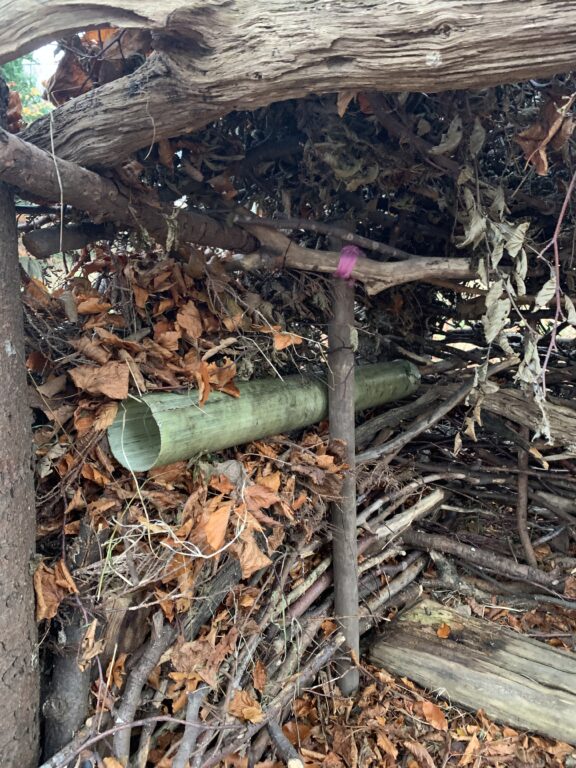
Entanglement
Location:
A campus with woodland is ideal.
Academic preparation:
Students attend a broad-ranging lecture at the beginning of the week on the hedgeland, its history and its ambiguous symbolism. From the lecture, students develop a good understanding of the role of the hedge in relation to commonage, enclosure, the demarcation of private property and also the post World War Two destruction of European hedgerows as part of land consolidation practices. They look at well-known examples from literary texts/cinema (eg the privet hedge in Harry Potter, the thorny barrier in Sleeping Beauty, the topiary skills of Edward Scissorhands) in order to understand the hedge as an ambiguously creative site, one that provides shelter and protects the human/non-human world but that also excludes. Contemporary visual art works are also explored to examine the hedge’s ongoing potential for artistic/creative inspiration. The hedge as a store of words and physical skills (illustrated through hedge maintenance tools) is also underlined. Literature by writers who explore the hedgeland in depth are also referenced as a way of exploring the rich lexicon of this place in different languages and places. (Lecture content is also reflected in alternative seminar materials should weather conditions mean the seminar needs to happen indoors.)
Practical preparation:
- Universities may require a Use of Grounds form and a Risk Assessment form.
- Students need to be informed to dress appropriately (esp waterproof clothing/footwear and work gloves).
- Prepare a check list of things that will be needed (and returned afterwards).
- We use a small trolley/wagon to take materials to the site where we work; it is also used for students to gather wood around the campus and bring it back to the site.
- Large flask for hot drinks: optional, but it creates conviviality and helps to strengthen the idea of team work on which the success of the activity is built.
- Weather forecast needs to be followed closely in advance, and indoor activities need to be ready as a contingency.
The activity (2-hour seminar):
The activity is not very structured. It has been designed to give students room to create in the moment, to learn by doing and to have fun. Some explanations can be given at the site about tools (and hedge-related vocabulary in different languages). However, it is interesting to give students free reign to organise themselves. Loose guidance can be given to support this: how/why it might be useful to break into small teams; discussing the shape/length/height of what they want to create; fixing uprights (it can be helpful to prepare in advance and use them to discuss ‘whittling’ and other wood-related skills); ensuring students organise in ways that allow them to gather a very good supply of wood. Beyond that, tutors may just wish to join in and/or watch what happens. Discussing lecture-based ideas, or broader module topics related to sustainability and care of the environment during the task is also a possibility.